
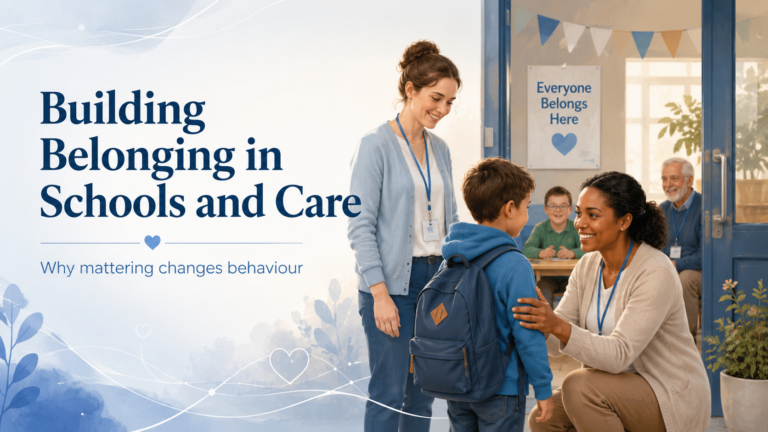
Imagine arriving at school and the first thing an adult says is, “Where is your pen?” Or entering a care setting and being spoken about before anyone speaks to you. Nothing dramatic has happened, but a message has still landed: the rule matters more than the relationship.
People are more likely to feel safe, engage and learn when they know they are accepted, remembered and valued. Belonging shapes behaviour management, autism support, dementia care and emotional wellbeing.
What is belonging?
Belonging is the feeling that I am accepted as part of a place, group or relationship and that my presence has value. It is more than being physically included. A child can attend school every day and still feel unwanted. A resident can live in a care home and still feel like a guest in somebody else’s workplace.
I find it useful to think about belonging through three ideas: acceptance, safety and mattering. Acceptance says, “You do not have to earn your humanity here.” Safety says, “You can take relational risks without expecting humiliation.” Mattering says, “Your presence makes a difference.”
Belonging is not the same as fitting in
Fitting in usually requires a person to work out the unwritten rules and reshape themselves around them. They may hide anxiety, suppress movement or copy other people’s communication. Belonging allows more authenticity. It still includes reasonable boundaries, but those boundaries do not demand that a person erase themselves.
This distinction matters when supporting autistic people. Some autistic children and adults mask natural responses to appear more socially acceptable. The behaviour may look compliant while the internal cost is exhaustion or anxiety.
Start by understanding unbelonging
Most of us have entered a room and immediately felt that we did not fit. For many people, that discomfort passes. For a child who has experienced repeated school changes, care placements, exclusions or disrupted relationships, unbelonging can become an expectation.
Consider what “fourteen placements” may mean: fourteen front doors, unfamiliar adults, different rules, lost friendships and repeated goodbyes. It is not simply a change of address. It can become a lesson that places and people do not last.
When that child keeps adults at a distance, our first assumption may be defiance. A more useful interpretation is that closeness has become risky. That does not make every behaviour acceptable, but it changes the question from “How do we make them comply?” to “What would make trust safer?”
How do I recognise whether somebody feels they belong?
People sometimes tell us directly. A child may say, “I like it here,” or, “I want to stay.” An adult may talk about feeling at home or being understood. Belonging can also show up when people:
- seek appropriate help rather than assuming they must cope alone;
- share preferences or disagreement without expecting rejection;
- recover more easily after mistakes;
- take part without constantly monitoring how they appear;
- show ownership of the space or routine.
These signs are not proof, so ask: “Where do you feel most yourself?” and “What makes this place easier or harder to be in?”
Use micro-messages that say, “I noticed you”
Belonging is rarely built by one impressive intervention. It grows through small messages: greeting somebody by name, remembering their football match, preparing for their arrival or noticing their contribution.
I once watched a teacher greet children at the school entrance. She knew every name. Some received a handshake, some a high five and some a gentle reminder about a book bag. The order mattered: connection first, correction second.
Compare “Those trainers are not allowed. Where is your pen?” with “Morning, Josh. Good to see you. How did the match go? We will sort your pen and trainers in a moment.” The second approach is not permissive. It simply protects dignity before addressing the boundary.
Become a better detective than judge
When behaviour challenges us, our brain quickly creates a story: rude, attention-seeking, manipulative, lazy or aggressive. Those labels feel certain, but certainty is not accuracy.
I encourage staff and families to ask:
- What happened immediately before this?
- What might the person be trying to gain, avoid or communicate?
- Are pain, sensory overload, fear, grief, confusion or fatigue involved?
- What did my tone, timing or body language add?
- What response would protect safety without increasing shame?
This is central to both Positive Behavioural Support training and effective behaviour management training. We are not excusing harm. We are trying to understand enough to prevent repetition and improve outcomes.
Let mattering compete with negative attention
Some people are mainly noticed when something goes wrong. They receive little response for coping or contributing, but immediate attention when they shout, disrupt or become aggressive. Difficult behaviour can become the most reliable route to visibility.
The answer is not to ignore distress. It is to create more safe ways for a person to experience significance. Give meaningful responsibility. Ask for their view. Notice effort. Let them help rather than treating them as a permanent recipient of help.
A useful test is: if this person stopped displaying behaviour that challenges tomorrow, how would they still know they mattered?
How can schools, care services and families build belonging?
I think of belonging as a web made from places, spaces and faces. If it depends on one exceptional adult, it remains fragile. A stronger culture creates several reliable points of connection.
1. Make the place intentionally welcoming
Look at the organisation from the perspective of somebody arriving anxious. Is the reception understandable? Does somebody acknowledge them? Do staff know they are coming?
NICE guidance for looked-after children and young people emphasises joined-up working, stable placements, nurturing relationships and support through transitions. Belonging is not one professional’s job. It is a system responsibility. Read the NICE guidance on looked-after children and young people.
2. Make spaces predictable without making them rigid
Explain changes, make routines visible and provide somewhere quieter when the environment becomes overwhelming. For autistic people, this may include reducing sensory load, offering processing time and avoiding pressure to communicate in one “correct” way.
In dementia care, belonging may be supported through familiar objects, preferred routines, meaningful roles and communication that protects identity. A person living with dementia may not remember the name of the building, but they can still experience whether the space feels warm, rushed or threatening. Our dementia training courses explore person-centred communication and meaningful engagement.
3. Help the faces remain calm, curious and consistent
People do not learn that adults are safe because we tell them once. They learn through repeated experience. We keep our word where possible, repair when we get it wrong and avoid turning mistakes into character judgements.
That consistency requires emotional intelligence and organisational support. Telling exhausted staff to practise self-care while leaving the conditions unchanged can become another demand. Reflective supervision, manageable expectations, team connection, recognition and training are forms of collective care.
A real-world snapshot: the child who pushes everyone away
Imagine a child enters a new placement after several previous moves. The adults are warm and the bedroom has been prepared, yet the child rejects activities, insults the carers and says they do not care whether they stay.
It is tempting to think, “After everything we have done, why are they behaving like this?” But trust is not a welcome pack. It is more like a bridge built one plank at a time. The child may need to test whether adults remain predictable when the relationship becomes difficult.
Belonging does not mean accepting violence or abandoning everybody else’s wellbeing. It means holding two truths together: “This behaviour cannot continue,” and, “You do not lose your place with us because today was difficult.”
That balance also matters in later life. Our course on understanding and responding to distressed behaviours helps caregivers consider triggers, communication and de-escalation rather than treating distress as deliberate disruption.
Who should use these strategies?
Belonging should be considered by teachers, foster carers, residential staff, social workers, healthcare teams, dementia caregivers, parents and managers. It matters wherever somebody depends on other people or systems for safety, learning, care or inclusion.
It is particularly important when supporting people who have experienced trauma, exclusion, disrupted attachment, autism, dementia, learning disabilities or mental ill health. These experiences are not identical, so we should resist forcing everyone into one explanation. The common question is whether the person expects their environment and relationships to be safe, understandable and responsive.
For teams supporting autistic children and adults, our range of autism courses can help staff develop more individual, sensory-aware and communication-friendly practice.
When to get support and training
Training becomes important when teams are repeatedly reacting to crises, staff responses are inconsistent, restrictive practice is increasing or people are described mainly through negative labels. The system may be focusing on correction without enough understanding, prevention or repair.
Good training should not provide a script for controlling people. It should improve confidence, shared language and reflective practice. The target is not obedience at any cost. It is positive outcomes for the person, the caregivers and the wider environment.
Build Safer, More Connected Support
- Positive Behavioural Support (PBS) training – build proactive, person-centred practice.
- Managing Challenging Behaviour – develop practical de-escalation and behaviour strategies.
- Understanding & Responding to Distressed Behaviours – understand anxiety, communication and triggers in dementia care.
- Autism Courses – build tailored approaches for education, care and health settings.
- Dementia Training – strengthen person-centred communication, identity and meaningful engagement.
Not sure where to start? Contact Able Training to discuss a training plan shaped around your team, setting and the people you support.
Further reading and trusted resources
- NICE: Looked-after children and young people – guidance on nurturing relationships, stable care and joined-up support.
- National Autistic Society: Masking – information about suppressing autistic characteristics and the possible impact on wellbeing.
- Skills for Care: Workforce wellbeing – resources for supporting wellbeing across adult social care teams.
Belonging begins with what we repeatedly demonstrate
Belonging is not created by demanding gratitude, participation or perfect behaviour. It grows when our responses demonstrate: “You are accepted. You are remembered. You are significant. You are safe enough to be yourself.”
Sometimes the most powerful behaviour support strategy is not a clever technique. It is the steady message: “You are one of us, and one difficult moment does not erase your place here.”
About Andy Baker
I’m Andy Baker, Managing Director of Able Training and a Behaviour Specialist. For over 17 years, I’ve helped schools, care providers and families create calm, dignified and effective support, particularly around behaviour management, autism and dementia care. My approach is practical, person-centred and evidence-informed, focused on helping people build safety, confidence, connection and compassion in practice. You can also listen to related discussions on the Able to Care podcast.