
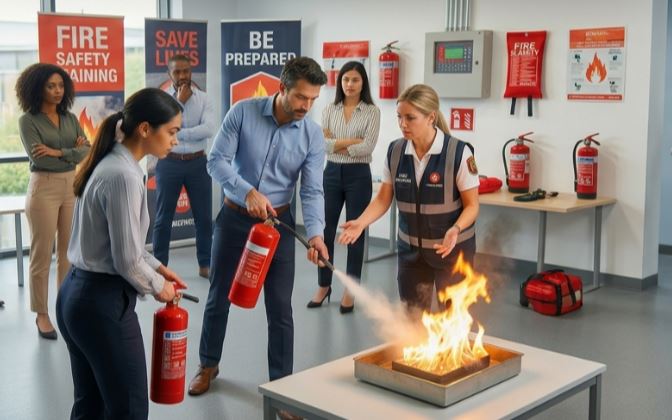
If you’ve ever wondered whether fire safety training is truly necessary or just another box-ticking exercise, you’re not alone. It’s a question that crosses the minds of many business owners, managers, and employees across the UK. The short answer is: yes, absolutely. But the full answer is far more interesting than a simple legal obligation.
Fire safety training saves lives, protects livelihoods, and when done properly gives everyone in a workplace genuine confidence to act in an emergency.
Let’s break it down properly!
Is Fire Safety Training a Legal Requirement in the UK?
Yes, and there’s no grey area here. Under the Regulatory Reform (Fire Safety) Order 2005, employers are legally required to provide information, instruction, and training to employees about fire precautions in the workplace. London Fire Brigade This applies regardless of the size of your business or the sector you work in.
The legislation places the responsibility of fire safety on the “Responsible Person” within an organisation — typically the employer or the person in control of the premises. That Responsible Person must ensure that employees receive adequate fire safety training and that effective measures are in place to prevent and mitigate fire risks. Morgan Fire
In short, if you employ people or manage a premises, this is your legal duty — not optional guidance.
Who Needs to Receive Fire Safety Training?
The simple answer is: everyone. All staff, including part-time staff, zero-hours contract staff, security staff, cleaning staff, and contractors, should be trained and instructed in key fire safety areas. No one on your premises gets a pass.
That training should cover what to do if a fire is discovered, how to raise the alarm, the location of escape routes, and how to assist anyone who may need help evacuating. It’s a legal requirement that all employees undergo basic training at induction, refresher training is given at regular intervals, and crucially, the training must be carried out by a competent team, someone with suitable and sufficient skills and knowledge.
That said, you can rely on Able Training for a secure and rich training sessions.
What Happens If You Don’t Provide Fire Safety Training?
The consequences of neglecting fire safety training go far beyond a stern letter. Legal penalties for failing to comply with UK fire safety regulations can include fines, imprisonment, and enforcement action. Serious breaches can result in unlimited fines and up to two years in prison.
Authorities may also issue enforcement or prohibition notices, which can restrict or even close a building.
But the legal consequences are only part of the picture. The real cost is human. Every year, hundreds of people across the UK are injured or killed in fire-related incidents that could have been prevented or at least better managed with proper training in place.
If you want to make sure your team is properly covered, Able Training offers accredited fire safety courses for businesses of all sizes across the UK.
How Often Should Fire Safety Training Be Refreshed?
This is a question that often gets overlooked once the initial training is ticked off. The truth is, fire safety isn’t a one-and-done job. The Fire Safety Order states that employees should be provided with adequate training when they are first employed and at regular intervals thereafter — normally every 12 months.
You should carry out at least one fire drill per year and record the results, which must be kept as part of your fire safety and evacuation plan. If your workplace layout changes, new equipment is introduced, or staff responsibilities shift, additional training should be arranged promptly — don’t wait for the annual review.
What Does Fire Safety Training Actually Cover?
A good fire safety training course is far more practical than people expect. It is a structured programme designed to educate employees on preventing fires, identifying hazards, responding appropriately in an emergency, and using fire safety equipment correctly.
For most employees, this means understanding fire hazards in their specific environment, knowing how to raise the alarm, learning evacuation routes and assembly points, and understanding what not to do in a panic.
For fire marshals and wardens, the training goes deeper by covering sweep procedures, roll call responsibilities, and how to assist colleagues with additional needs during an evacuation.
Does Fire Safety Training Apply to Small Businesses Too?
Absolutely. There’s a common misconception that fire safety training is only a concern for large organisations with dozens of staff. That’s simply not true. The Regulatory Reform (Fire Safety) Order 2005 applies to virtually every non-domestic premises in England and Wales — whether you’re running a small café, a corner shop, or a large manufacturing site.
In fact, smaller businesses can sometimes face greater risk, as they may have fewer staff to manage an evacuation, less formalised processes, and limited resources dedicated to health and safety. Getting the right training in place early is far cheaper – financially and ethically than dealing with the fallout of an incident.
If you’re a small business owner unsure where to start, Able Training provides straightforward, cost-effective fire safety training tailored to businesses of all sizes.
Frequently Asked Questions (FAQs)
Is fire safety training a legal requirement in the UK?
Yes. Under the Regulatory Reform (Fire Safety) Order 2005, all UK employers must provide adequate fire safety training to every employee — starting at induction and repeated at regular intervals, typically annually.
How often does fire safety training need to be renewed?
Fire safety training should be refreshed at least once a year. Additional training is required whenever there are changes to the workplace layout, new equipment, or a change in staff roles and responsibilities.
What are the consequences of not having fire safety training?
Failing to provide fire safety training can result in unlimited fines, enforcement notices, closure of your premises, and in serious cases, up to two years in prison. Beyond the legal penalties, the risk to your staff and visitors is significant.
Final Thoughts
Fire safety training isn’t a bureaucratic inconvenience. It’s a fundamental part of running a safe, responsible workplace in the UK. It’s legally required, practically essential, and most importantly; it genuinely protects the people who walk through your doors every day.
Whether you’re an employer ensuring compliance or an employee wanting to feel prepared, investing in proper fire safety training is always the right call.