
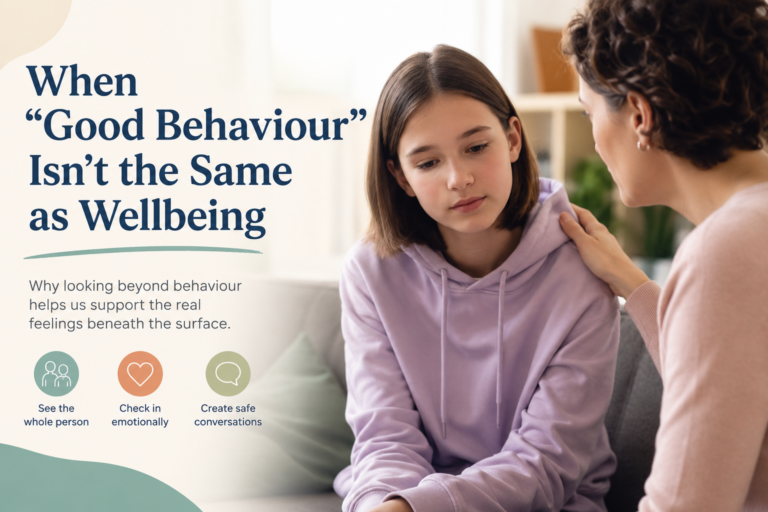
When “Good Behaviour” Isn’t the Same as Wellbeing
“They’ve been so good lately.”
It is a phrase many of us have used before. Parents say it. Teachers say it. Care staff say it. Managers hear it in handovers, team meetings and daily updates.
On the surface, it sounds positive. It usually means someone has not shouted, refused, disrupted, become distressed or needed additional support. It may mean they have followed instructions, stayed quiet, completed tasks or appeared settled.
But here is the question we need to ask more often:
Are they genuinely okay, or have they simply stopped showing us that they are struggling?
In care, education and family life, it is easy to measure what we can see. Behaviour is visible. Incidents can be logged. Actions can be recorded. But wellbeing is not always as obvious. Someone can appear calm on the outside and still feel anxious, unsafe, overwhelmed or unheard on the inside.
Why Behaviour Does Not Tell the Whole Story
Behaviour is important. It can tell us something about how a person is coping, communicating or responding to their environment. But behaviour should never be the only thing we measure.
If a child, young person or adult has previously shown distress through shouting, refusal, withdrawal, aggression or repeated questions, we may feel relieved when those behaviours reduce. In some cases, that reduction may be a positive sign. It may show that the person feels safer, better understood and more supported.
However, it can also mean something very different.
Sometimes people stop showing distress because they have learned it is safer not to. They may have learned that being quiet gets approval. They may feel that asking questions causes frustration. They may believe that being “good” is the only way to be liked, accepted or kept close.
This is why we need to be careful not to confuse compliance with contentment, or quietness with wellbeing.
The Risk of Mistaking Compliance for Progress
In many settings, especially busy care homes, classrooms, children’s services and family environments, quiet behaviour can easily be seen as improvement.
A person who used to ask lots of questions may stop asking. A child who used to seek reassurance may become quiet. A resident who used to express frustration may become withdrawn. A pupil who used to challenge instructions may suddenly become overly compliant.
That might look easier from the outside, but it is worth asking what has changed underneath.
Have they developed more trust and confidence? Or have they started masking how they feel?
The National Autistic Society describes masking as something some autistic people may do, consciously or unconsciously, to appear non-autistic or to fit in socially. While masking is often discussed in relation to autism, the wider idea is relevant in many situations. People who have experienced trauma, anxiety, rejection, punishment or repeated misunderstanding may also learn to hide their true feelings to stay safe or avoid negative reactions.
This means a person can look settled while actually feeling under pressure. They may be holding everything in. They may be trying to avoid upsetting others. They may be performing the version of themselves that they think adults, staff, carers or teachers want to see.
Quietness Can Sometimes Be a Red Flag
We should not assume that every quiet person is struggling. Some people are naturally quiet, calm or reflective. The concern is when quietness represents a noticeable change, especially when it comes alongside other signs.
For example, it may be worth looking more closely if someone is:
- speaking less than usual
- eating or drinking less
- sleeping more or struggling to sleep
- flinching, avoiding eye contact or appearing tense
- stopping activities they used to enjoy
- becoming unusually compliant or eager to please
- withdrawing from friends, staff, family or peers
- appearing calm, but no longer laughing, playing or engaging
These changes may not show up as “behavioural incidents”, but they can still tell us something important.
In schools, a pupil who becomes “the easy one” may be overlooked because they are no longer causing concern. In care settings, a resident who stops expressing distress may be described as settled, even if they are actually disengaging. At home, a child who becomes unusually helpful may be trying to prove they are good enough to avoid rejection or conflict.
When we only notice behaviour that disrupts us, we risk missing distress that is quiet, hidden or internalised.
Looking Beyond Incidents
Incident records can be useful, but they only tell part of the story. A week with “no incidents” is not automatically a week of good wellbeing.
For care staff, teachers, managers and parents, it can help to look at a wider picture. Instead of only asking whether someone has behaved well, we can also ask:
- Have they seemed genuinely relaxed?
- Have they been eating and drinking normally?
- Have their sleep patterns changed?
- Have they been joining in or isolating themselves?
- Have they laughed, played, smiled or shown interest?
- Have they been able to say no appropriately?
- Have they expressed preferences, needs or worries?
- Does their body language match what they are saying?
This is especially important in person-centred care and education. Skills for Care highlights person-centred approaches as an important part of supporting people well in health and social care. A person-centred approach means seeing the whole person, not just the behaviour that is easiest to record.
Better Questions to Ask
Small changes in language can make a big difference to how we understand someone’s needs.
Instead of asking:
“Have they behaved this week?”
We could ask:
- How have they seemed emotionally?
- Have they looked genuinely settled, or just quiet?
- Have they been engaging with people and activities?
- Have they seemed more withdrawn than usual?
- When did someone last check how they are actually feeling?
- Are they able to express frustration, sadness or worry safely?
These questions move the focus away from behaviour management alone and towards emotional wellbeing, safety and connection.
For children and young people, this also links closely to social, emotional and mental wellbeing. NICE guidance on social, emotional and mental wellbeing in education highlights the importance of supporting wellbeing in schools and education settings, rather than only responding when concerns become more visible.
Making Emotional Check-Ins Normal
One practical way to support wellbeing is to make emotional check-ins part of everyday routines.
This does not need to be complicated. It might include:
- a simple traffic light system for mood
- emotion cards
- private check-in conversations
- visual scales
- regular key worker or tutor conversations
- quiet opportunities for someone to say how they feel without pressure
The key is to make these tools feel normal, not like something only used when there is a problem.
It can also be powerful when adults model this too. In a school, care home, family or support setting, emotional check-ins should not feel like something being “done to” a person. They should feel like part of a shared culture where everyone is allowed to notice, name and talk about feelings safely.
A simple phrase can help:
“You can be behaving well and still not feel okay. Both things can be true.”
Why This Matters for Care Homes, Schools and Families
When we equate good behaviour with wellbeing, we may miss the early signs that someone needs support.
We may miss the child who has stopped asking questions because they feel like a burden. We may miss the resident who appears calm but has stopped engaging. We may miss the pupil who is masking anxiety all day and releasing it at home. We may miss the adult who is compliant because they feel powerless, not because they feel safe.
Real support means looking beyond whether someone is easy to manage. It means asking whether they feel heard, safe, valued and able to be themselves.
This matters because people should not have to reach crisis point before their needs are noticed.
A Reflective Question for Your Team
Think of someone you support who has been described recently as “good”, “settled” or “much better”.
Now ask yourself:
When did we last check how they are actually feeling?
Not just whether they followed the routine. Not just whether they avoided incidents. Not just whether they were quiet.
How are they really?
That question can change the whole direction of support.
Final Thoughts
Good behaviour can be positive, but it is not the same as wellbeing.
A quiet person is not always a settled person. A compliant person is not always a confident person. A person with no recorded incidents is not automatically a person who feels safe, connected or understood.
Whether you work in care, education or support someone at home, the challenge is to look beneath the surface. Notice the small changes. Ask better questions. Create safe opportunities for people to express how they feel.
Because the goal should never simply be quiet, compliant people.
The goal should be people who feel safe, supported, heard and genuinely okay.
Training and Support
At Able Training, we support care, education and health professionals to understand behaviour, emotional wellbeing and person-centred support in a deeper and more practical way.
Explore our related training courses, including Positive Behaviour Support Training, designed to help teams respond with confidence, compassion and understanding.
Positive Behaviour Support Training
Mental Health Training Courses