The Invisible Lion

A free practical guide for carers, families, educators and professionals on understanding fight, flight, freeze and fawn responses in behaviour that challenges.
Name(Required)
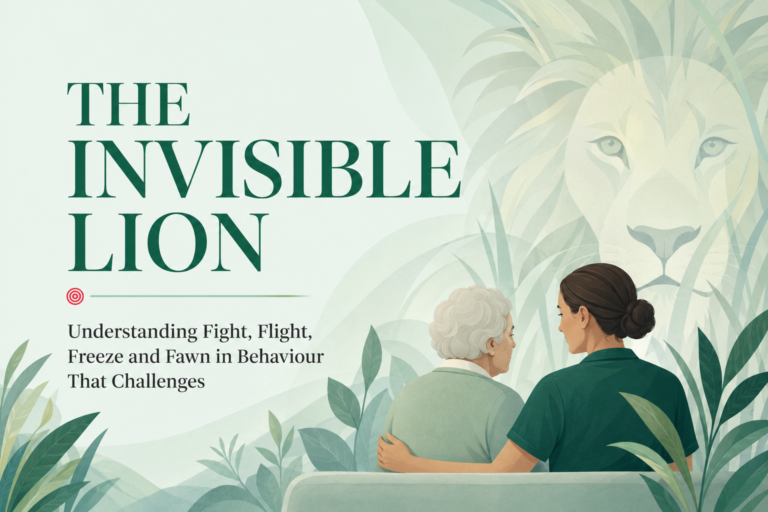
The Invisible Lion behaviour guide featured image showing a calm support moment with a subtle lion, representing fight, flight, freeze and fawn responses in behaviour that challenges.

Understanding Fight, Flight, Freeze and Fawn in Behaviour That Challenges

The Invisible Lion is a free practical guide for carers, families, educators and professionals who support people whose behaviour can sometimes be described as challenging, distressed or difficult to understand.

When someone shouts, runs away, shuts down, refuses to engage or appears overly compliant, it can be easy to focus only on the behaviour we can see. But behaviour is often the surface. Underneath, the person may feel unsafe, overwhelmed, frightened, trapped, confused or unable to cope.

This guide introduces the idea of the “invisible lion”: the threat we may not see, but the person’s nervous system may still be reacting to. Their brain may be responding as though danger is present, even when the situation does not appear dangerous to us.

Inside the guide, you will learn how fight, flight, freeze and fawn can show up in real-life behaviour. These survival responses may appear as aggression, refusal, avoidance, anxiety, shutting down, masking, people-pleasing or appearing “fine” when the person is not fine.

This resource is designed to support a more trauma-informed and understanding-led approach to behaviour. Instead of asking only, “How do we stop this behaviour?”, it encourages carers and professionals to ask, “What might this person be afraid of?”

This free behaviour support resource is suitable for:

  • Family carers and unpaid carers
  • Care home and residential care staff
  • Support workers and health and social care professionals
  • Teachers, SEN staff and education teams
  • Foster carers and children’s services teams
  • Dementia care teams
  • Learning disability and autism support services
  • Managers and trainers supporting staff around behaviour that challenges

The guide also includes a simple response process to help reduce threat, use fewer words, give space, respond to fear rather than only behaviour, and reflect afterwards without blame.

Complete the short form on this page to download your free copy of The Invisible Lion.

What's in this guide?

  • What the “invisible lion” means in behaviour support
  • Why behaviour that challenges may be a sign of distress or fear
  • How emotional dysregulation can affect behaviour
  • What fight, flight, freeze and fawn responses can look like
  • Why someone may shout, refuse, avoid, shut down or mask when they feel unsafe
  • How past experiences, trauma or fear can shape present reactions
  • Why correction, punishment or long explanations may increase distress
  • How to lower the sense of threat using calm, space and fewer words
  • How to look for possible triggers such as noise, change, pain, demand or feeling trapped
  • Helpful phrases to use when someone appears to be in survival mode
  • A quick checklist for responding safely and reflecting afterwards
  • Why safety and regulation should come before correction