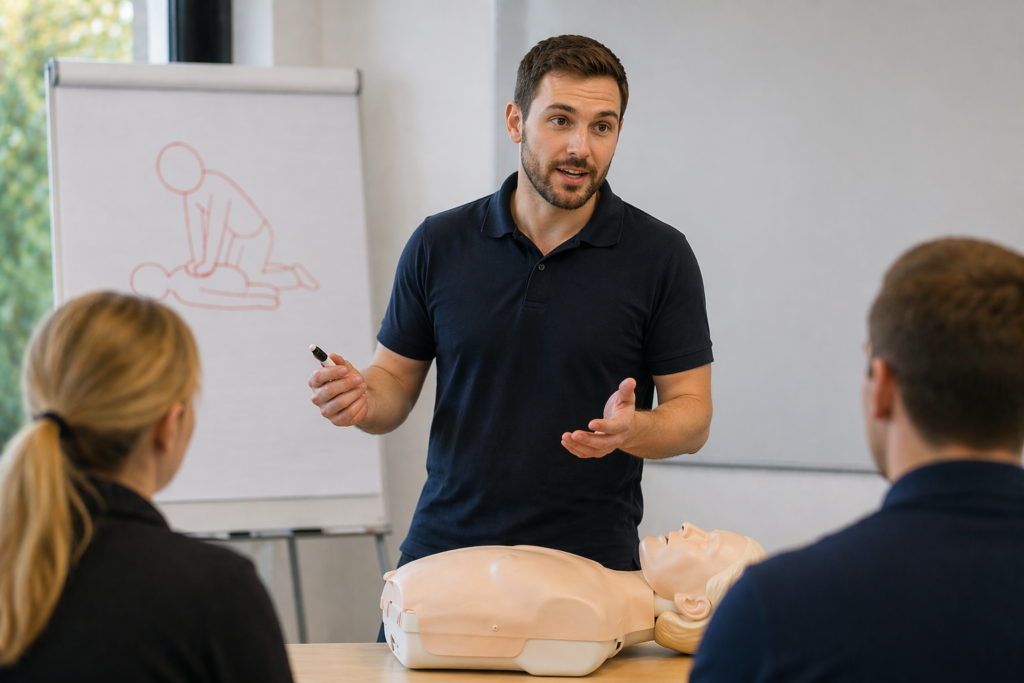

Learn the roles and responsibilities of a first aider as well as how to correctly perform first aid on an adult, child and infant.
How do you assess an incident? What differences are there when aiding a child, infant or adult with CPR or an AED? What should you do when a casualty is choking, or their airway is obstructed? What breathing and circulation disorders can become an issue? What are the different types of wounds? How should you respond to each type of wounds? What are some of the different types of bleeding? How should you respond to each type of bleeding? What is shock and how should this be treated? How should you correctly deal with burns and scalds on adults, children, and infants? What is wound packing? What is a tourniquet and how is it used? What is a catastrophic bleed?
Our QA Level 3 Award in Combined Emergency First Aid at Work (EFAW) and Emergency Paediatric First Aid (EPFA) course will help you answer the questions above and more.
It is estimated that 621,000 workers sustained a non-fatal injury at work and over 600,000 people became injured at work in a year.
Statistic here
Through our EFAW and EPFA course, you will gain an understanding of the roles and responsibilities a first aider has. You will learn the importance of the control of infection. You will learn the importance of consent within first aid. You will learn what an accident/ incident report is. You will understand what personal protective equipment is. You will learn what scene surveying is. You will understand what to do when a casualty is unresponsive and not breathing. You will learn how to correctly perform CPR on an adult, child, and infant. You will learn how an AED should be used. You will learn what a seizure is and how to aid an individual in the event of a seizure. You will learn how to recognise, treat, and assess when a casualty is chocking or has a blocked airway. You will learn how to recognise and treat shock. You will learn how to recognise and treat external bleeding and minor injuries.
What you'll learn.
- Identify the role and responsibilities of a first aider and a paediatric first aider.
- Understand how to minimise the risk of infection to self and others.
- Be aware of the need for consent to provide first aid.
- Recognise the difference between an infant and a child for the purpose of first aid treatment.
- Interpret how to conduct a scene survey.
- Gain knowledge of how to conduct a primary survey of a casualty.
Who is QA Level 3 Award in Combined Emergency First Aid at Work (EFAW) and Emergency Paediatric First Aid (EPFA) for?
Our QA Level 3 Award in Combined Emergency First Aid at Work (EFAW) and Emergency Paediatric First Aid (EPFA) course is suitable for any individuals who work in settings where a responsibility exists to look after both adults and children and wish to act as an Emergency First Aider in the workplace. Upon successful completion of this qualification, candidates will be equipped with the essential skills needed to give safe, prompt, and effective first aid to all age groups in emergency situations.
What are the learning outcomes?
- By the end of the course, you will be able to…
- Understand the roles and aim of an Emergency First Aider.
- State the recording and reporting procedure in the event of an accident or incident.
- Assess a scene and prioritise treatment.
- Perform a primary survey on a casualty.
- Recognise life-threatening conditions.
- Understand how situations or conditions become life-threatening.
- Perform cardiopulmonary resuscitation and defibrillation on an adult, child, or infant casualty.
- Move a casualty into a safe airway position.
- Download course brochure