
Learn how to identify the need for consent to then provide first aid as well as to understand the difference between an infant and child for the purposes of first aid treatment.
What is the role and responsibilities of a first aider? What can you do to minimise the risk of infection to self and/ or others? Why is consent important within first aid? What is the difference between infant and child treatments? How do you conduct a scene survey and a primary survey? When is assistance needed? When should you administer (CPR)? How do you provide CPR to an infant, child and adult? How do you put a casualty into the recovery position and when should you do this? How do you correctly monitor a casualty breathing? How do you administer first aid to a casualty that is experiencing a seizure? How do you know when a casualty is choking? How do you administer first aid to a casualty that is choking? What is shock? How do you administer first aid to a casualty that is in shock? When is external bleeding life-threatening? How do you administer first aid to a casualty with external bleeding? What treatment should be used to treat small cuts, grazes, bumps, grazes, small splinters, nosebleeds, bites, and stings. How do you determine the severity of a burn/ scold and when should first aid be administered? How do you pack a wound? What is a tourniquet and when should this be used? How do you deal with a catastrophic bleed? How do you administer first aid to a casualty with an eye injury? What are the functions of the respiratory system? What are the functions of the circulatory system? What is hypoxia? What is asthma? What is hyperventilation? How do administer first aid for a fracture? What is anaphylaxis and an allergic reaction? What is a heart attack? What is a stroke? What is epilepsy? What are the treatments for febrile convulsions? What is meningitis? What is diabetes? What are poisonous substances? What can an electric shock cause to the human body? What is hypothermia and heat exhaustion? What are the different types of wounds?
Our QA Level 3 Award in Combined First Aid at Work and Paediatric First Aid course will help you to answer the questions above and more.
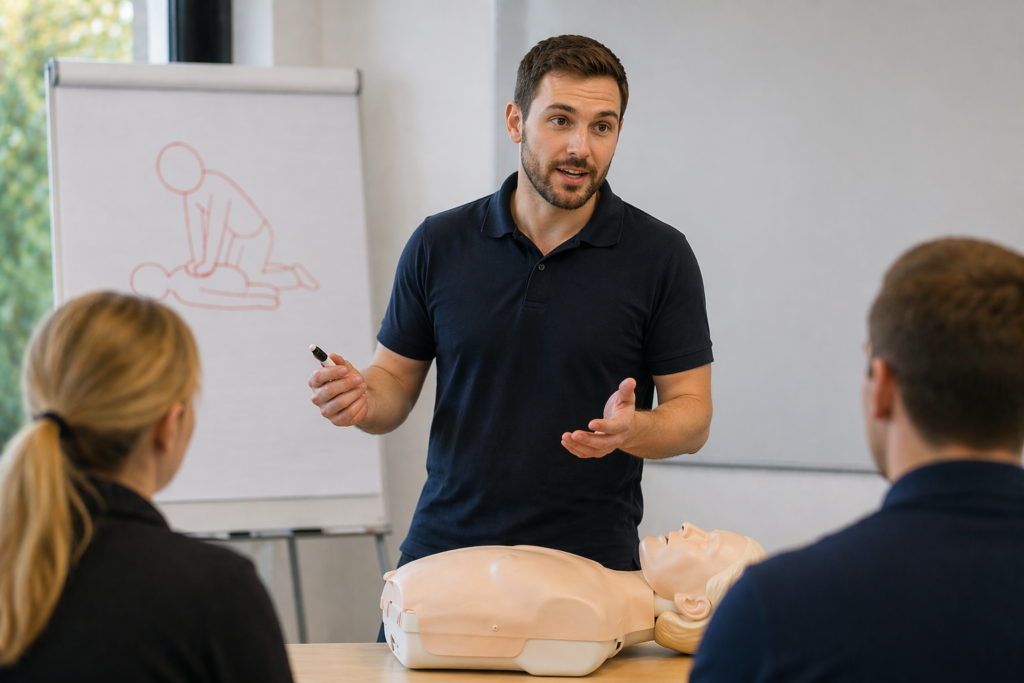
Our First Aid at Work and Paediatric First Aid course is specially designed course enables candidates to gain the skills and knowledge needed to provide both adult and pediatric first aid, whilst minimising the number of training days required to achieve both qualifications. Candidates will cover a range of topics needed to provide effective first aid for adults, children and infants including CPR and defibrillation, choking, stroke, head injuries, asthma and much more. You will learn how to recognise and treat casualties needing CPR or an AED. You will learn how to identify when a casualty is choking, suffering with shock, has an external bleed, has a minor injury, has a burn or scald, an eye injury, asthma, a fracture, an allergic reaction or anaphylactic reaction, suffers from a heart attack, a suspected stroke, has epilepsy, suspected meningitis, has diabetes, suspected sudden poisoning and incidents involving electricity.
What you'll learn.
- What roles and responsibilities a First Aider and Paediatric First Aider has.
- Understand how to correctly assess an incident.
- Be aware of how to provide correct CPR and AED for adults, children and infants.
- Recognise when a casualty is choking or has an airway obstruction.
- Understand disorders of breathing and circulation.
- Gain knowledge regarding wounds and bleeding, burns and scalds, seizures and epilepsy, fractures, strains and sprains, head, neck and spinal injuries, eye, nose and ear injuries, anaphylaxis, asthma and allergic reactions, heart attack and stroke, diabetes, and poisoning.
- Interpret when emergency services should be contacted.
Who is QA Level 3 Award in Combined First Aid at Work and Paediatric First Aid for?
This course is suitable for any individual who works within a setting where a responsibility exists to look after both adults and children and wish to act as a First Aider in the workplace. Upon successful completion of this qualification, candidates will become equipped with the essential skills needed to give safe, prompt and effective first aid to all age groups in a variety of emergency situations.
What are the learning outcomes?
- By the end of the course, you will be able to…
- Understand the roles and aim of an Emergency First Aider.
- State the recording and reporting procedure in the event of an accident or incident.
- Assess a scene and prioritise treatment.
- Perform a primary survey on a casualty.
- Recognise life-threatening conditions.
- Understand how situations or conditions become life-threatening.
- Perform cardiopulmonary resuscitation and defibrillation on an adult, child or infant casualty.
- Move a casualty into a safe airway position.
- Assist a choking casualty.
- Treat minor injuries.
- Recognise and treat shock.
- Manage a casualty with a suspected fracture and apply an appropriate sling.
- Recognise and treat a poisoned casualty.
- Understand the signs and symptoms of heart attack and stroke.
- Demonstrate the correct treatment for a casualty experiencing a seizure.
- Know how to recognise anaphylaxis and use an adrenaline auto-injector (Epi-Pen).
- Know how to recognise and treat an asthmatic casualty.
- Understand how to treat and manage a casualty with suspected spinal or head injury.
- Download course brochure