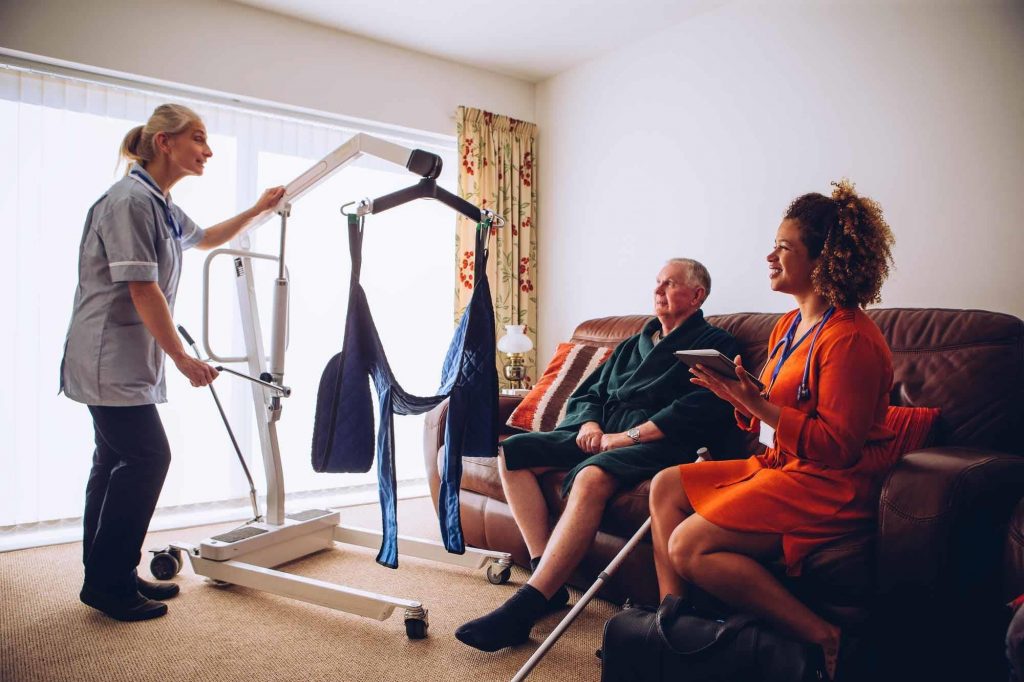

Moving People Safely Hoist, two care workers with elderly man and hoist.

Moving and Handling People

Our Moving and Handling People enables attendees to gain knowledge regarding the principles of safe moving and lifting loads.

"*" indicates required fields

This field is for validation purposes and should be left unchanged.

Trusted by over 1000 businesses throughout the UK

Learn the reasons for safe manual handling and the techniques to put into practice.

What is Manual Handling? What are the golden rules of manual handling? What is the impact of manual handling injuries? What are the principles of safer moving and handling? What legislation is involved? What is RIDDOR? What is PUWER? What is LOLER? What are causes of back pain and injury? What is a hoist check? What equipment is available to safely move a person? Why are drag lifts unsafe?

Our Moving and Handling People course will help you to answer the questions above and more.

Through our Moving and Handling People course; you will develop practical manual handling of people skills to put into practice. Staff will learn about the relevant legislation.

What you'll learn.

  • What legal requirements are associated with moving and handling people.
  • Understand the basic structure and function of the spine.
  • Be aware of the main components of a risk assessment.
  • Recognise the causes of back pain.
  • Gain knowledge of the principles of safe moving and handling of people.

Who is Moving and Handling People for?

Our Moving and Handling People course is suitable for all employees who need to understand the principles of safe moving of people. The course is a good mix of theory and practical learning ensuring staff are up to date with best practices and uses of various equipment.

What are the learning outcomes?

By the end of the course, you will be able to…

  • State Manual Handling legislation.
  • Define manual handling and its potential risks
  • Describe the nature of muscular skeletal injuries.
  • List the causes of back pain.
  • Be able to perform risk assessments when moving people or objects.
  • Demonstrate good use of relevant moving and handling equipment and techniques.
  • Develop knowledge, skills, and principles to safely move people.

Get a quote

"*" indicates required fields

This field is for validation purposes and should be left unchanged.
{{ reviewsTotal }}{{ options.labels.singularReviewCountLabel }}
{{ reviewsTotal }}{{ options.labels.pluralReviewCountLabel }}
{{ options.labels.newReviewButton }}
{{ userData.canReview.message }}

Frequently Asked Questions

How do you safely move people?
Safely moving people involves clear communication, assessing their needs, and ensuring a safe environment free of obstacles. Providing appropriate assistance and using necessary equipment like wheelchairs or stretchers helps maintain comfort and safety. Coordination among team members, ongoing communication, and emergency preparedness ensures a secure and dignified transfer process.
People must be moved safely to prevent injury or harm. Proper handling ensures their physical well-being, avoids aggravating existing conditions, and maintains their dignity and comfort throughout the process. This approach also reduces the risk of accidents and ensures that any necessary medical or mobility needs are properly addressed.
The Redcrier theory of moving people safely in care settings stresses thorough assessment of individuals’ needs, detailed planning including environmental factors and equipment, clear communication throughout, proper technique to prevent injury, prioritising safety with equipment and post-movement review for continuous improvement and feedback from all involved. It aims to ensure both physical safety and emotional comfort.

Related Courses

Receive a bespoke quote.

Give your team the training they need.

"*" indicates required fields

This field is for validation purposes and should be left unchanged.
Please enter a number greater than or equal to 1.
Consent to personal data processing
Receive marketing information and promotions
  • Tailored Learning: Our programs are adaptable to meet every learner’s needs.
  • Quality Assurance: Proudly accredited by UKAS ISO 9001, BILD, ICM, Qualsafe Awards, and Ability Training Awards.
  • Lasting Partnerships: Our commitment extends beyond the classroom as we aspire to forge lasting partnerships

Talk to the team

Get instant answers to all your questions

Drop us an email [email protected]

8:30am–4:30pm — Monday to Friday

(except bank holidays)
Contact Us, man using phone and laptop sat on sofa