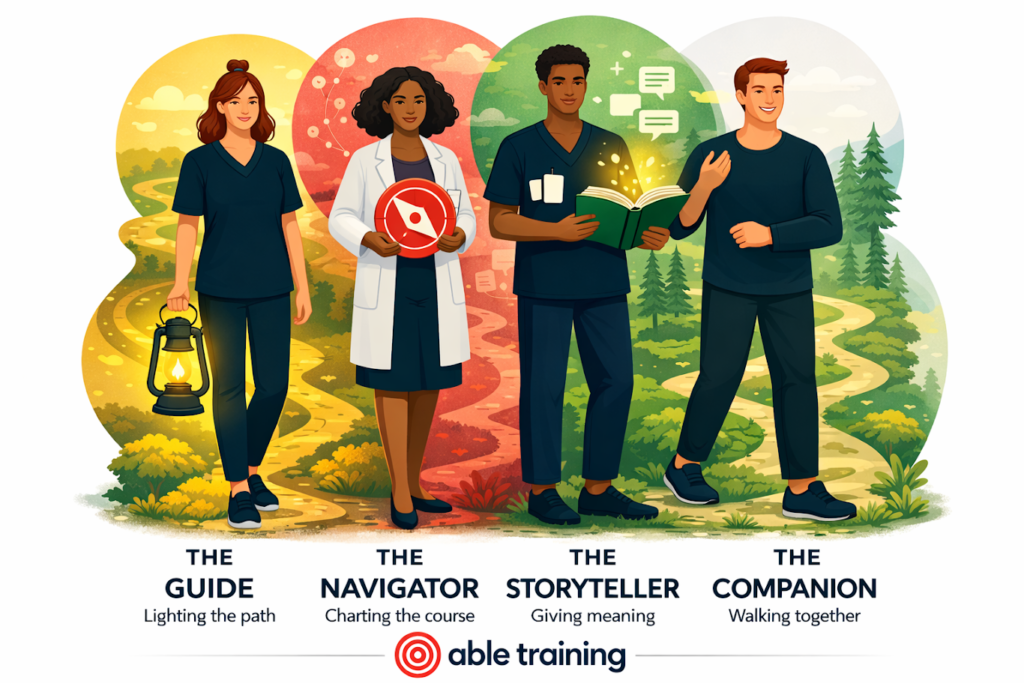

professional boundaries

Professional Boundaries Training

Our Professional Boundaries course enables attendees to determine professional boundaries and identify responsibilities in practice as well as understanding the importance of professional boundaries within health and social care.

"*" indicates required fields

This field is for validation purposes and should be left unchanged.

Trusted by over 1000 businesses throughout the UK

Learn the differences between clear and unclear boundaries as well as how to recognise and report breaches of professional boundaries within the workplace.

What are therapeutic relationships? What is a professional boundary? Why are professional boundaries important within the workplace? What are some consequences of poor professional boundaries? How are professional boundaries established? Who should negotiate boundaries? What can be involved within a boundary violation? What factors impact professional boundaries? What are the 3 stages of burnout? What are some examples of healthy boundaries? What drives a healthy boundary? What is vicarious or secondary trauma? What is boundary transgression?

Our Professional Boundaries course will help you to answer the questions above and more.

Professional boundaries are a set of guidelines, expectations and rules which set the ethical and technical standards in the social care environment. They set limits for safe, acceptable, and effective behaviour by workers.

Through our Professional Boundaries course, you will gain an understanding of what a professional boundary is. You will develop an understanding of how to identify responsibilities in practice. You will learn why professional boundaries are important in health and social care. You will learn how to distinguish between clear and unclear boundaries. You will learn what professional and unprofessional behaviour is. You will learn how a boundary may be broken. You will learn what processes should be in place to prevent a boundary from being breached.

What you'll learn.

  • What therapeutic relationships are as well as what a professional boundary is.
  • Understand the consequences of poor professional boundaries on staff within the workplace.
  • Understand the impact a breach of a professional boundary can have on an individual.
  • Recognise the importance of what factors are impacted upon.
  • Understand what stress and a burnout is.

Who is Professional Boundaries Training for?

Our Professional Boundaries course is for everyone. Whatever care or non-care sector you work in our session would be suitable to provide knowledge of the importance of setting boundaries within the workplace as well as the managers role during a breach.

What are the learning outcomes?

By the end of this course, you will be able to…

  • Explain what a therapeutic relationship is.
  • Discuss professional boundaries and identify responsibilities in practice.
  • Recognise and report breaches of professional boundaries.
  • Be able to state the meaning and risks of dual relationships.
  • Demonstrate professional behaviour and identify risk factors and boundary concern.
  • Develop knowledge, skills and strategies that will increase your knowledge about professional boundaries.

Get a quote

"*" indicates required fields

This field is for validation purposes and should be left unchanged.
{{ reviewsTotal }}{{ options.labels.singularReviewCountLabel }}
{{ reviewsTotal }}{{ options.labels.pluralReviewCountLabel }}
{{ options.labels.newReviewButton }}
{{ userData.canReview.message }}

Frequently Asked Questions

What are appropriate professional boundaries?
Appropriate professional boundaries include maintaining confidentiality, managing time effectively, and using respectful communication. Physical contact should be limited to professional needs with clearly defined personal and professional roles, setting guidelines for gift-giving, and avoiding unprofessional social media interactions are also essential for maintaining healthy working relationships.
Professional boundaries in healthcare are essential for maintaining a trusting and effective relationship with patients. Here are some key examples: 1. Confidentiality: Protecting patient information and maintaining privacy. 2. Dual relationships: Avoiding personal relationships with patients. 3. Physical boundaries: Respecting personal space and avoiding inappropriate touch. 4. Emotional boundaries: Maintaining professional detachment while offering empathy and support. 5. Time boundaries: Adhering to appointment times and avoiding over-commitment. 6. Gift-giving: Establishing clear guidelines for accepting gifts. 7. Social media: Avoiding patient contact on social media platforms.
Maintaining professional boundaries is crucial for a healthy and effective working relationship. Here are some key strategies: 1. Clear communication: Explicitly state your professional role and limitations. 2. Consistent application: Ensure boundaries are applied equally to all clients or patients. 3. Self-awareness: Recognize your own personal and emotional needs. 4. Seeking support: Consult with colleagues or supervisors when facing challenges. 5. Professional development: Continuously enhance your knowledge of professional ethics. 6. Documentation: Maintain clear and accurate records of interactions.

Related Courses

Receive a bespoke quote.

Give your team the training they need.

"*" indicates required fields

This field is for validation purposes and should be left unchanged.
Please enter a number greater than or equal to 1.
Consent to personal data processing
Receive marketing information and promotions
  • Tailored Learning: Our programs are adaptable to meet every learner’s needs.
  • Quality Assurance: Proudly accredited by UKAS ISO 9001, BILD, ICM, Qualsafe Awards, and Ability Training Awards.
  • Lasting Partnerships: Our commitment extends beyond the classroom as we aspire to forge lasting partnerships

Talk to the team

Get instant answers to all your questions

Drop us an email [email protected]

8:30am–4:30pm — Monday to Friday

(except bank holidays)
Contact Us, man using phone and laptop sat on sofa